
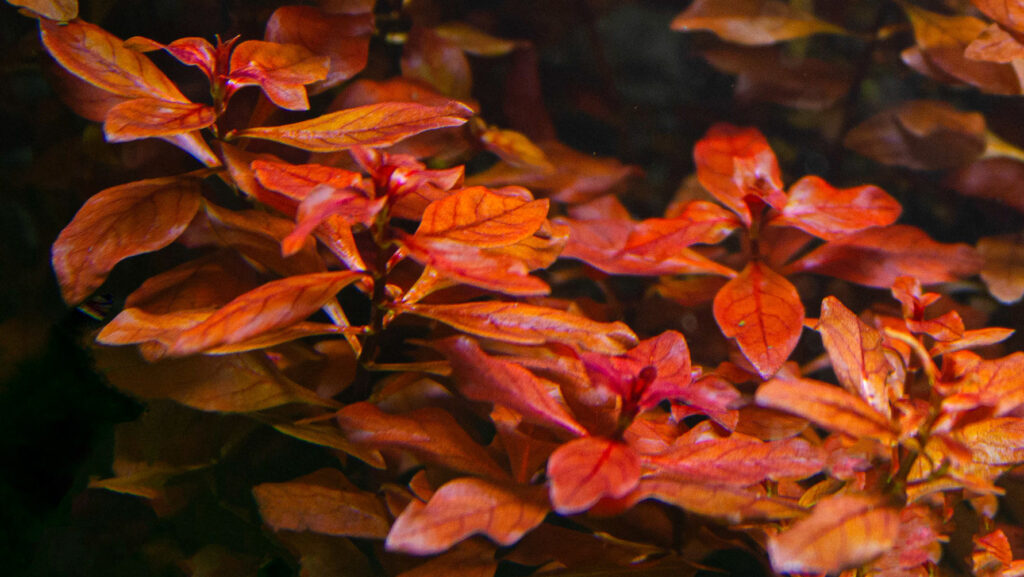
Aquarium plants do far more than decorate a tank. They take up waste nutrients, add oxygen during the day, give shy fish and fry somewhere to hide, and hold eggs and bubble nests for the species that breed among them. Growing them well comes down to a handful of things: light, nutrients, CO₂, a good substrate and a little routine care.
How plants feed themselves
Plants make most of their own food through photosynthesis. Inside the green cells of the leaves, chlorophyll uses light to turn carbon dioxide and water into sugars, releasing oxygen as a by-product. Everything else a plant needs, from nitrogen to iron, has to come from the water or the substrate. If any one of these is missing, growth slows to the pace of the scarcest factor, no matter how generous the others are.
Light
Light is the engine of a planted tank. How much a plant needs depends on the species: mosses, ferns and Anubias are happy in modest light, while red and fine-leaved stem plants need much brighter conditions.
- Duration: 8 to 10 hours a day suits most tanks. Longer days rarely help the plants and often feed algae. Start a new tank at around 6 hours and increase slowly.
- Colour temperature: lamps rated roughly 5,000 to 7,000 K give a natural look and a spectrum plants use well.
- Intensity: the old rule of “watts per litre” no longer works with modern LEDs. Compare lamps by their output (lumens or PAR) and by the plant groups the manufacturer recommends them for.
- Balance: strong light raises the demand for CO₂ and nutrients. More light without them simply grows algae.
Nutrients
Like garden plants, aquatic plants need macronutrients in larger amounts and micronutrients in traces. Most take them up through their leaves, while rooted plants such as Echinodorus and Cryptocoryne also feed heavily through their roots.
- Nitrogen (N), phosphorus (P) and potassium (K) are the main building blocks. Fish waste supplies some nitrogen and phosphate, but in a well-planted tank it is rarely enough. Potassium is almost always in short supply.
- Iron (Fe) is needed to make chlorophyll. Red plants in particular use a lot of it, and pale new leaves are a classic sign of shortage.
- Trace elements such as manganese, zinc, copper and boron take part in many small but essential processes.
- Calcium and magnesium come with the water hardness. In soft or RO water they need to be added back.
An all-in-one fertiliser such as LGND Avalon or LGND Essential covers most tanks. Heavily planted, high-light setups benefit from adding single nutrients as needed: LGND Nitrogen, LGND Phosphat, LGND Potassium and LGND Florebit Ferrum Fe. In soft water, LGND Evenness restores the minerals plants rely on. Dose little and often rather than once a month, and adjust to how the plants respond.
CO₂
Carbon is the element plants use most, and in an unaided aquarium it is nearly always the limiting factor. Adding CO₂ makes growth faster and denser, lets demanding species thrive and helps plants outcompete algae.
- Aim for roughly 20 to 30 mg/l during the lighting period. A drop checker shows the level at a glance: blue means too little, green is right and yellow means too much.
- A pressurised system with a precise regulator, such as the LGND Titan Pro CO₂ Regulator, gives the most stable results.
- Switch CO₂ off at night with a solenoid or timer. In the dark, plants stop using it and the level can rise high enough to stress fish.
- Increase CO₂ gradually and watch the fish. Gasping at the surface means the level is too high.
Substrate and root feeding
A planted tank needs a substrate deep enough for roots, usually 5 to 8 cm. Fine gravel or a dedicated plant soil works far better than coarse stones, which leave gaps that roots cannot use. Root feeders benefit from extra nutrition placed directly in the substrate: LGND BioPlant Primary Sticks push nutrients to the root zone, while LGND Root Wellness supports healthy root growth. Never use ordinary garden or potting soil, which can cloud the water and release unwanted fertilisers.
Filtration and water flow
Gentle, even flow carries CO₂ and nutrients to every leaf and stops debris settling on them. Too much flow tears delicate plants and uproots new cuttings, so aim for steady movement rather than a strong current. Under-gravel filters are a poor match for planted tanks, as the constant flow through the substrate disturbs the roots.
Routine care
- Remove dead or yellowing leaves before they rot and release waste into the water.
- Trim fast-growing stem plants regularly so they do not shade the plants beneath them.
- Keep the glass clean with a scraper or the LGND Algae Master Brush, so the light reaches the plants.
- Use proper aquascaping tools for planting and trimming to avoid crushing stems.
When plants struggle
New plants often lose a few leaves after planting. Many are grown above water at the nursery, and their emersed leaves “melt” as the plant adapts to life underwater. If the roots and rhizome are healthy, new submerged leaves soon follow.
If established plants begin to decline, check the basics. Pale or yellow new growth points to a lack of iron or nitrogen. Holes in older leaves often mean potassium is short. Tall, stretched stems with large gaps between leaves suggest the light is too weak, or that the plant is shaded by its neighbours. Stunted growth with algae on the leaves usually means the light is too strong for the available CO₂ and nutrients.
How aquarium plants reproduce
Most aquarium plants rarely flower underwater and spread by vegetative means instead, which makes them easy to multiply.
- Rhizomes: Anubias and Java fern grow along a creeping rhizome. Cut it into pieces, each with a few leaves, to make new plants. Never bury the rhizome in the substrate, or it will rot.
- Cuttings: stem plants such as Bacopa, Ludwigia, Limnophila and Hygrophila are propagated by cutting off the top and replanting it. The cutting roots from the nodes along the stem.
- Runners: Vallisneria, Sagittaria and many carpeting plants send out runners with daughter plants that can be separated once they have roots.
- Daughter plants: Echinodorus can form new plants on its flower stems, and Java fern grows plantlets on its leaves.
- Epiphytes: Java moss, Anubias and Java fern attach to wood and stone. Tie them on with cotton thread or fishing line until the roots take hold, then remove the line.
Choosing and placing plants
Plan the layout by height. Tall plants such as Vallisneria and Cabomba belong at the back, medium plants in the midground, and low, carpeting species like dwarf Cryptocoryne or Riccia at the front, where the light can reach them. Floating plants such as Amazon frogbit, Salvinia and Pistia shade the tank and absorb nitrate quickly, but should not cover the whole surface.
Match plants to your fish as well. Angelfish and discus suit tall, Amazonian-style planting with swords and Vallisneria. Tiger barbs and other nibblers are best kept with tough species such as Java fern and Anubias. Large cichlids such as Oscars dig up and destroy most plants, so rocks, wood and sand work better there.
Buy healthy plants with firm, green leaves and white roots, and inspect them for damage, snails or algae before planting. Handle stems gently, as crushed stems tend to rot.
Common questions
What temperature does a planted tank need?
Most tropical plants grow well at 22 to 26 °C. Some species prefer cooler water, so check each plant’s needs before buying.
When can I add plants to a new aquarium?
Straight away. Planting before you add fish helps the tank mature, as the plants start absorbing waste from the very beginning.
Why are my plants pearling?
Small oxygen bubbles on the leaves show that photosynthesis is running at full speed, usually thanks to good light and plenty of CO₂.
Can I use houseplants in an aquarium?
No. Terrestrial plants slowly rot underwater and pollute the tank. Only use true aquatic plants.
In short: balance is everything. Match the light to your plants, supply CO₂ and a complete fertiliser in step with it, give root feeders a nutritious substrate, and keep up with simple routine care. Healthy, dense planting is the best long-term protection against algae.